

Blog Feed

The Market and The Companies & The Impact COVID-19 has on Advertising

This year the COVID-19 pandemic affected lots of businesses and most of our lives have changed. But what impact has this had on Digital Advertising? This Mintel research shows some views on the change of the market and the companies.

Firstly, the COVID-19 outbreak has caused a drop in digital advertising spending as brands become more conscious about their spending in this time when the economic activity is low. The good news is that people are spending more time online and online shopping increased. This means a good opportunity for marketers to try different platforms and new ways of engaging with customers.

Secondly, and most surprisingly for me, this research showed nearly two in three (64%) think it is appropriate for brands to reference the outbreak. For me, this one is a very interesting marketing strategy because from my experience many people would not like to hear about the pandemic in an ad. After all, most of the news you see on the internet is about the pandemic.

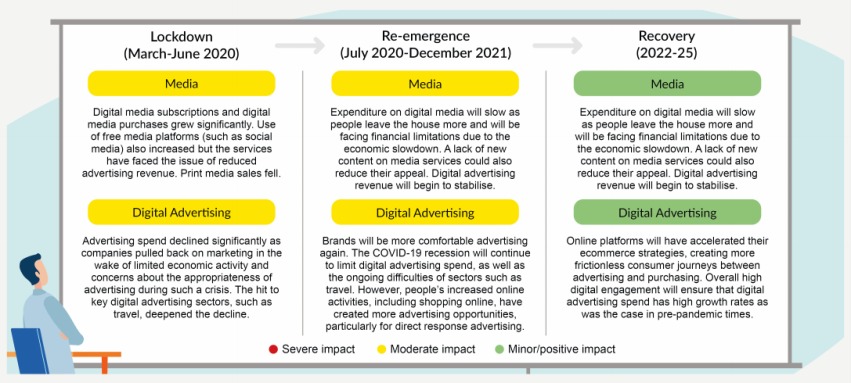
The image below shows the short, medium and long-term impact of COVID-19 on media and digital advertising :
Source : Mintel

Some of the impacts on the market and companies:

  • Digital ad spends set to fall by 10% in 2020. Mintel forecast that the digital ad spend will recover quickly, with 17% growth in 2021;
  • Facebook’s advertising revenue grew 10%, although many companies in the US boycotted advertising on Facebook as part of the #StopHateForProfit campaign organised by the Anti-Defamation League and NAACP. Over 1,000 advertisers publicly joined the boycott, including major brands such as Coca-Cola, Hershey and Unilever. The campaign was due to concerns over harmful content on the social media platform, such as hate speech and fake news;
  • Google announced its first revenue decline in history, the result of an 8% decline in advertising revenue;
  • Amazon’s revenue, which is made up primarily of advertising revenue, grew by 41% with far smaller advertising business than Google or Facebook;
  • Twitter reported that advertising revenue was down 23%;
  • Advertising junk food online and on TV before 9pm is banned;
  • Another industry that is also facing further bans on advertising is the gambling industry;
  • The COVID-19 outbreak has increased online activity, presenting opportunities for online advertising;

How companies decided to innovate the market:

  • Facebook and Instagram launched the “Shops” tab, helping businesses to have an e-commerce platform they can use;
  • YouTube introduced shoppable video ads;
  • TikTok is currently testing a “shop now” button in influence’s’ feeds. Also, they launched TikTok for Business, a new platform for brands and advertisers;
  • Snapchat launched its first brand-facing campaign, ‘Meet the Snapchat Generation’. The campaign aimed to highlight the importance of the platform to Gen Z, showcase what is special about the Snapchat community and how seriously the platform takes social responsibility. The five main themes of the campaign are:
    • Taking social responsibility;
    • Building community;
    • Celebrating individuality;
    • Nurturing friendships;
    • Communicating in new ways;
  • Pandora creates conversational voice ads, an ad voice format that could talk back to people and allow interaction. As more people incorporate voice assistants into their lives, on speakers and smartphones, people will be increasingly accepting of being advertised to via voice.

The Impact of COVID-19 on Advertising: The Consumer

In the first part of my blog, I described the effects of the COVID-19 pandemic on the market and on some of the big companies (e.g, Facebook, Google, Amazon) when it comes to digital advertising. Now, based on the same Mintel research, I will show you the latest news when it comes to the consumer perspective on online ads and more.

Consumer behaviour towards online advertising :

  • 79% of people think it is important to know that companies protect their personal information;
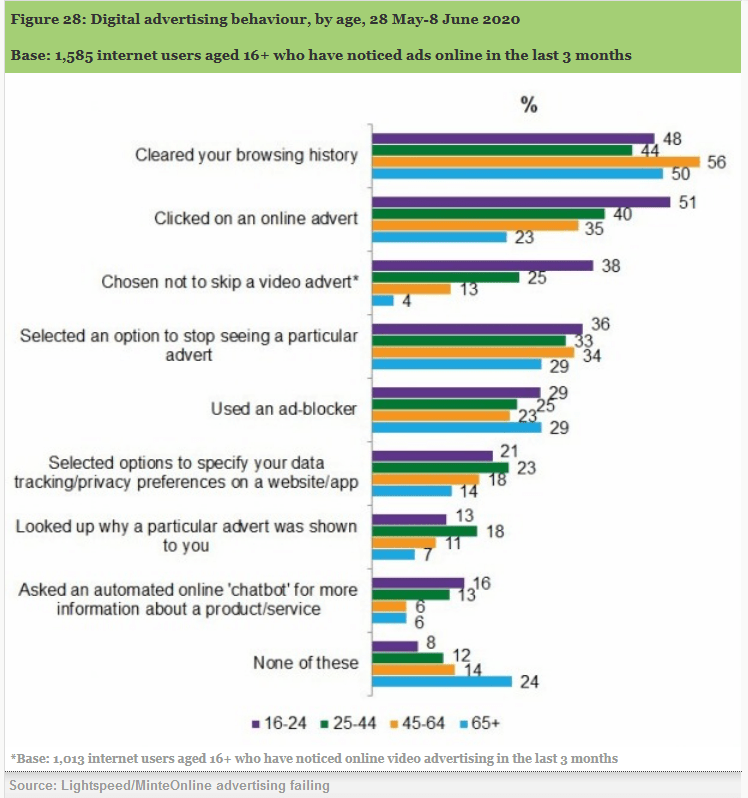
  • Half of the people who notice online adverts have cleared their browsing history in the last three months, rising to 60% among men aged 55+;
  • More companies are introducing real-time messaging apps to offer customer service;
  • Younger people are significantly more likely to click on an online advert and to choose not to skip a video advert, mostly because young people are already comfortable with online ads;
  • Older people are particularly unlikely to click on online adverts, with only 14% of men aged 65+ having done so compared to 31% of women of the same age group;

As we can see in the graph below, older generations were the most sceptical regarding online ads, with 29% having an ad-blocker and 24% not even being interested in noticing ads. Brands and marketers should find more ways to connect online with older people.

However, younger generations are more comfortable with the idea of specifying their data preferences on a particular website or to communicate with an online “chatbot”.

The question asked was “Which of the following have you done in the last 3 months? m. Please select all that apply.”

Consumer preferences :

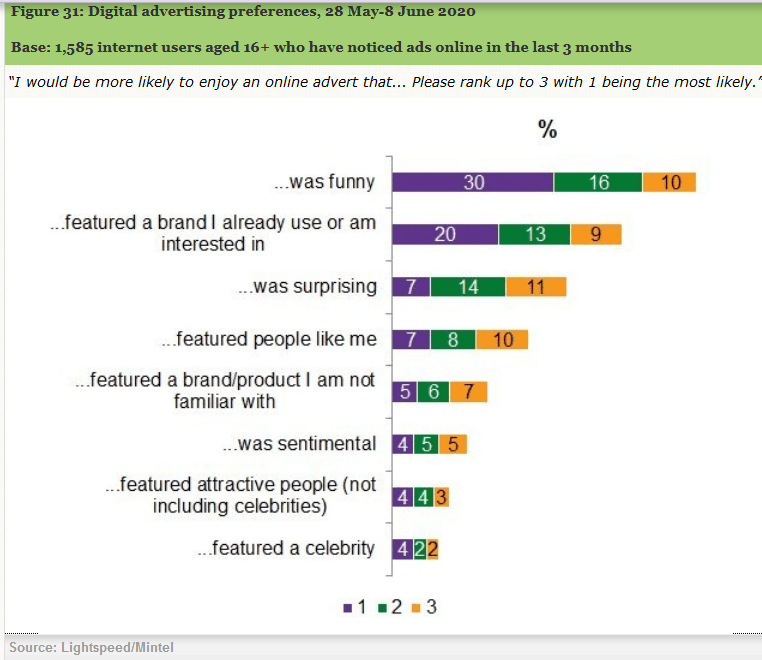
  • The main factor that causes people to enjoy online adverts is if it is funny. But brands have to be aware that there is a thin line between being funny and maybe offending some potential customers, that’s why self-deprecation can be the easiest way to make an advert funny, by making fun of your own brand or the people in the ad itself;
  • 21% of 16-24 year olds enjoyed a sentimental ad compared to 6% of over-55s, perhaps due to how easily sentimentality can be seen as manipulative or inauthentic;
  • Many people are more likely to enjoy an advert if they are familiar with the brand or the featured people in the ad. However, brands must be careful to do not repeat themselves by showing the same ad and products to the customer who already bought it;

Customer frustrations :

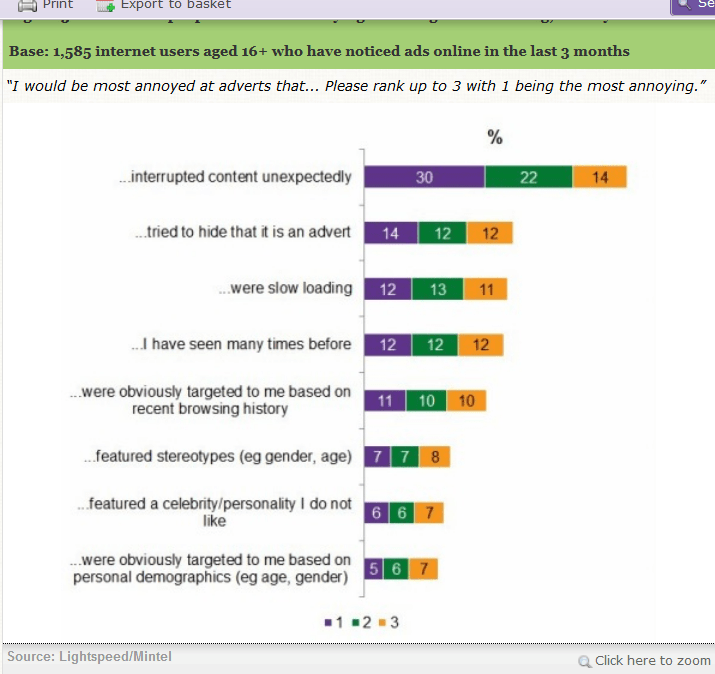
  • People were most annoyed by adverts that interrupted their content unexpectedly (e.g mid-roll ads in a Youtube video). One solution for the brands would be to have more clear creators showing where adverts will be (and how long they will be).
  • Brands should be transparent and should not try to disguise their ads. The best example of this is when brands try to incorporate an ad into their content (e.g Youtube) without making it clear in the video title/description that your video is sponsored.
  • Young women are most likely to be annoyed by stereotypes when it comes to gender. Last year, the Advertising Standards Authority (ASA) banned the ads for Philadelphia cream cheese and Volkswagen, following complaints from the public that they perpetuated harmful stereotypes.
  • Older generations are not liking the idea of being targeted based on their personal data, which could be a result of not wanting to be defined by being older and the type of advertising they feel targets older people;

.

The Digital Behaviors And Attitudes Of Students

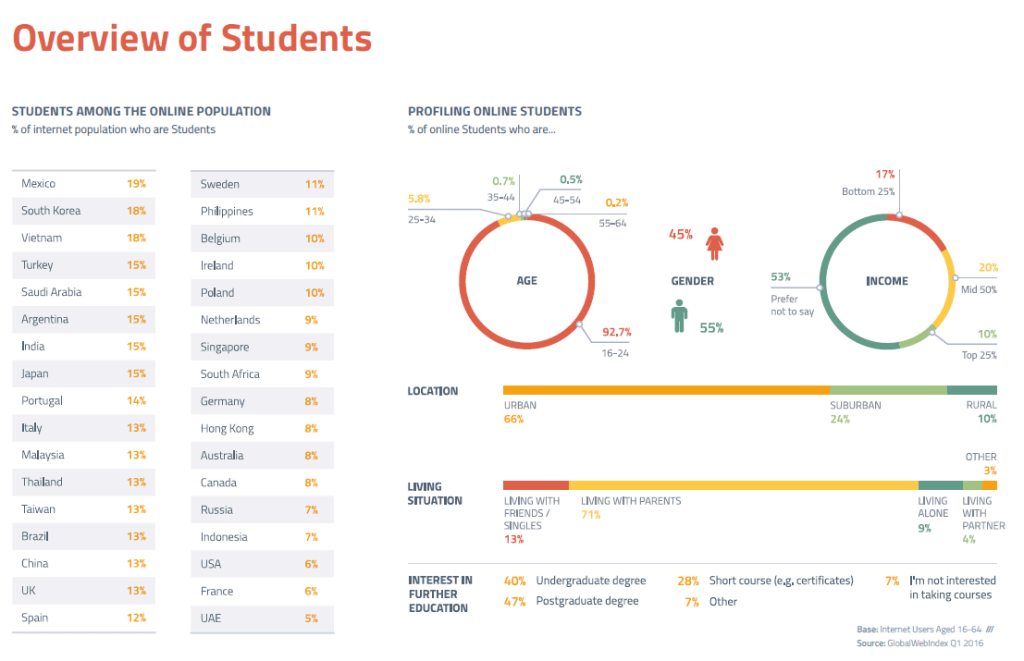
On a survey done by 5,198 students aged 16-64 from 2016, we were presented the following:

  • Overview of Students – What are the main demographic traits and characteristics of this group?
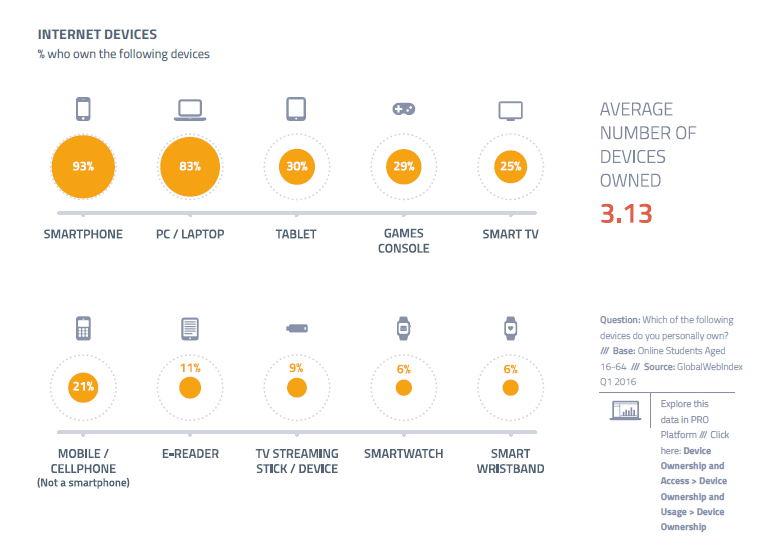
  • Device Ownership and Usage – How long are the students spending on mobiles each day and which other devices do they own?
  •  Online Behaviours – How many hours do they spend consuming media and what do they do when they second-screen?
  •  Social Networking – Which social networks do they use, and how do students behave inside the social space?
  • E-Commerce & Brand Engagement – How many students are buying online? How do Students research and discover brands and how do they interact with them? What reasons would encourage them to promote a brand online?
  1. 1 Overview of Students
A screenshot of a cell phone

Description automatically generated

The usual student is aged between 16-24 years old, living mostly in the urban area probably with their parents and most of them want to have a postgraduate degree after they finish university.

  1. 2 Device ownership and usage
A screenshot of a cell phone

Description automatically generated

Nowadays, as you probably know, it is a must to have a smartphone and a laptop as a student to socialize and text with your friends, which makes 93% out of students to own a smartphone and 83% own a laptop or a PC. 1 in 3 students own a tablet or a game console like PlayStation or Xbox and 25% of the students use a smart TV.

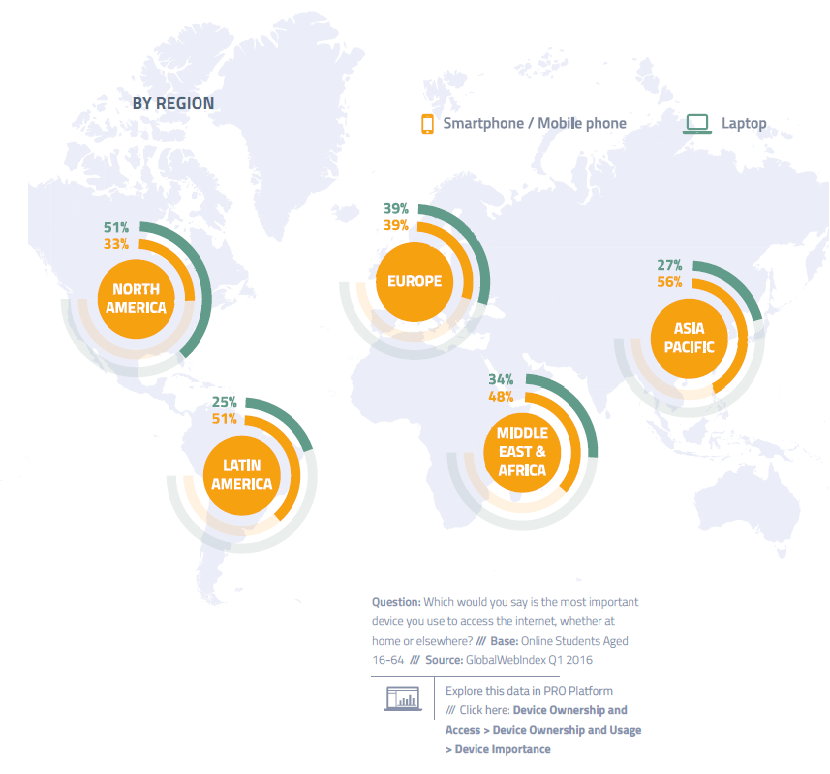
For Students, smartphones stand out as their most important device for getting online, with a considerable lead over the second-placed which is the laptop (51% vs 31%). The tablets are not considered essential anymore in the daily life of a student, being easy replaced by smartphones in time.

A screenshot of a social media post

Description automatically generated

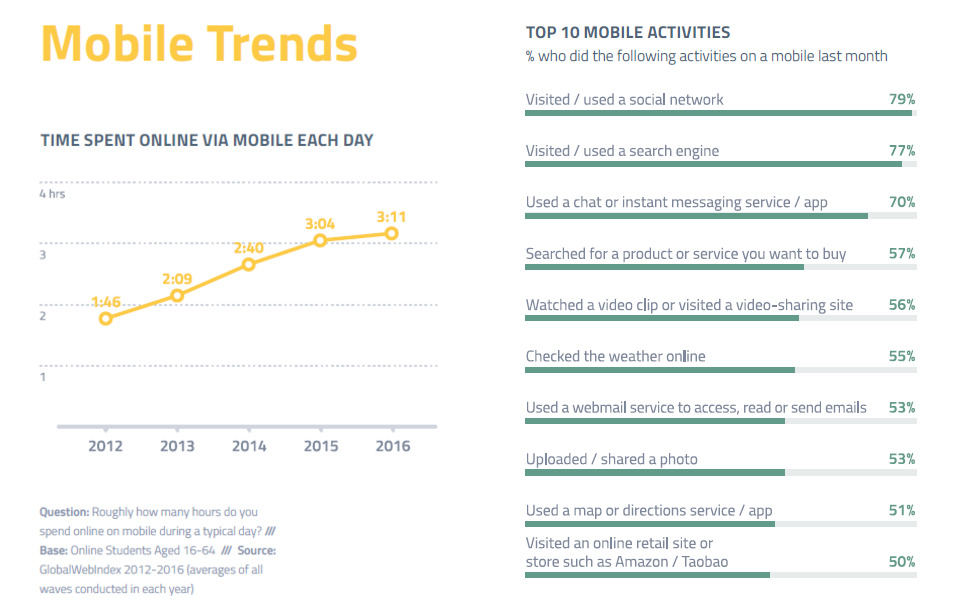
From 2012 to 2016 there was an increase in the daily time spent online from 1:46 hours/day to 3:11 hours/day, almost twice the amount of time compared to 2012. 8 in 10 students are social networking most of the time and 7 in 10 students are using a messaging service. Other students choose to search for a product or service they would like to buy or simply just checking the weather.

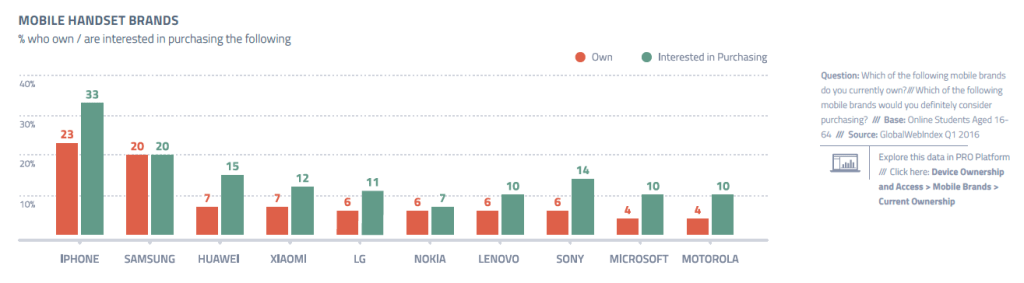
When it comes to what mobile brands students use, most of the students own an iPhone or a Samsung and also a big majority would like to buy one of these two brands.

  1. 3 Online Behaviours
  • Daily media consumption
A screenshot of a cell phone

Description automatically generated

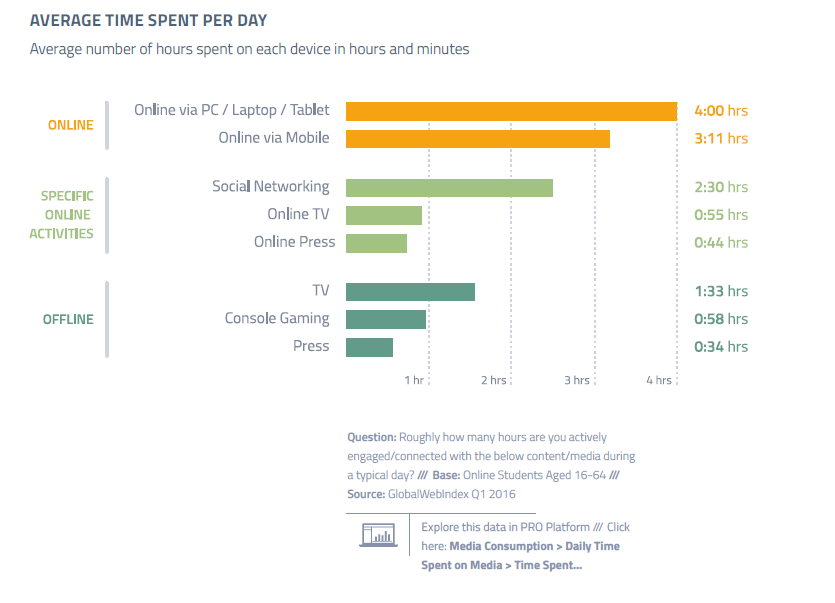
As we can observe from the image above, most of the time spent online Is via PC / Laptop / Tablet with an average of 4 hours per day and via mobile with an average of 3:11 hours per day. In this time, the usual student chooses to use social networking as an activity, with the online TV and online press less watched. Offline, the TV is leading the usage of time with 1:33 hours per day, students spending less and less time watching TV.

  • Paying for online content
A screenshot of a cell phone

Description automatically generated

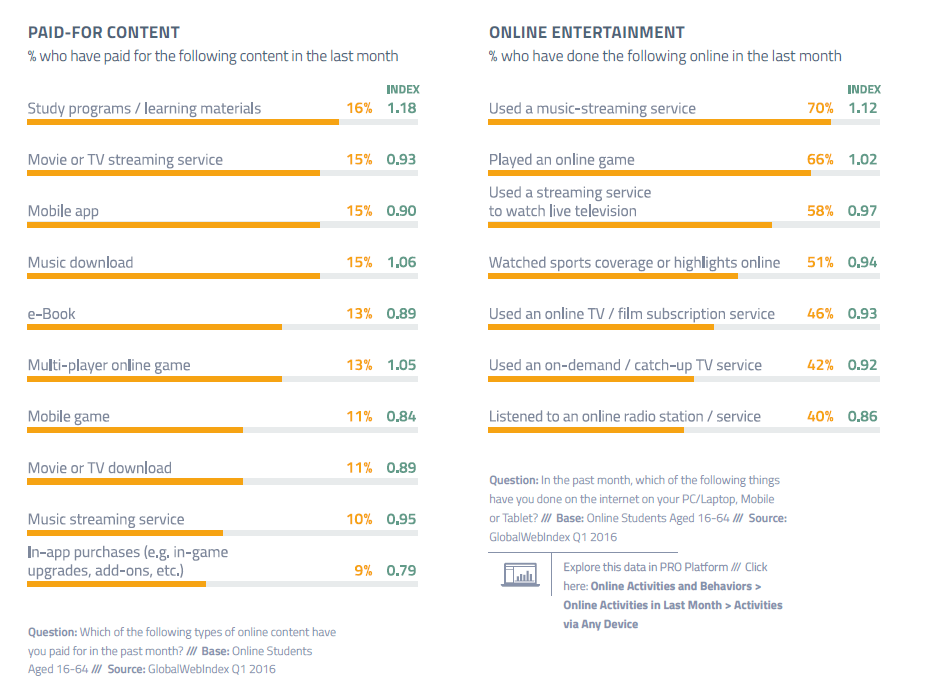
Each month, 1 of 2 students purchase some form of digital/online content. But there is a big gap between the numbers of students who use an online product/service and the number of students who pay for it. For example, 7 out of 10 among this group are using a music-streaming service but just 1 out of 10 are paying for it. Another example is that 46% are using a TV/film subscription each month but just 15% are stating that they are paying for that service.

  • Gaming


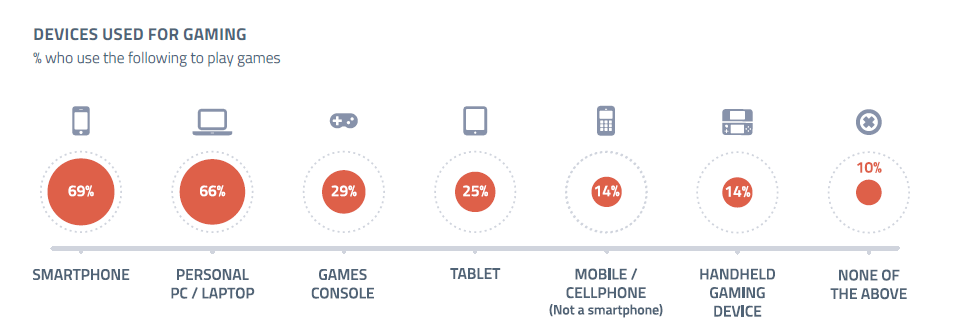
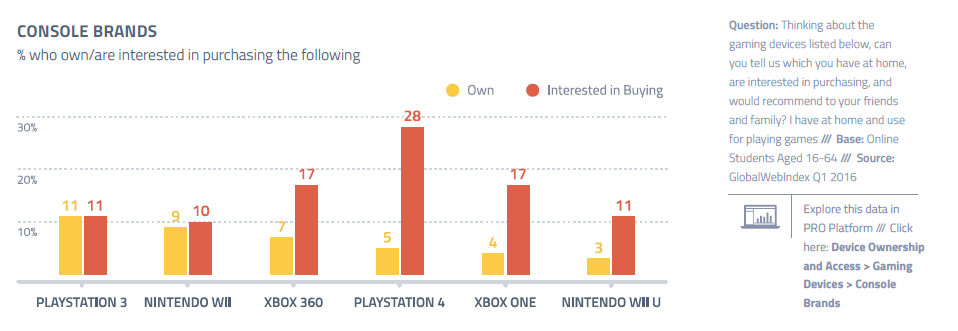
Surprisingly, more people are gaming on a phone than on a PC or laptop. 29% of them are playing games on a games console. Most of them own a PlayStation 3 and are interested in buying a PlayStation 4 or an Xbox One.

  • Second Screening

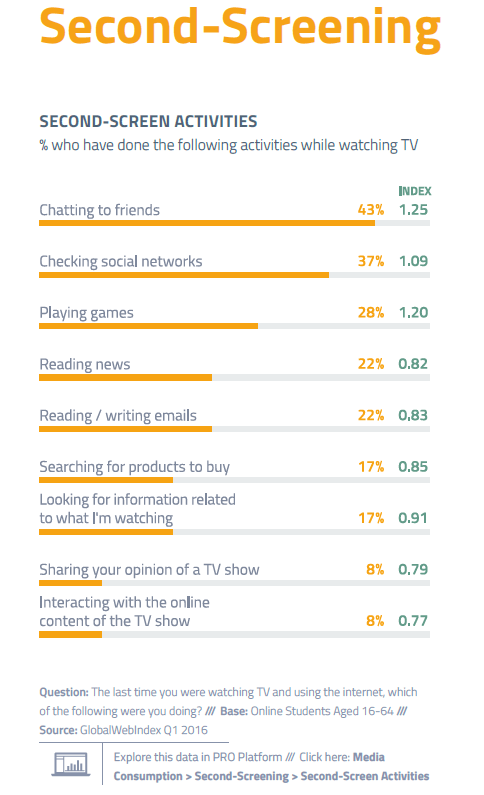
Globally, 84% of Students are now second-screening while watching TV, being 25% more likely than the average internet user to be chatting with friends (43%) or checking social networks (37%). 3 in 10 prefer to play games instead, and 22% of the students like to read news or e-mail while watching TV.

  • Social Media and messaging apps

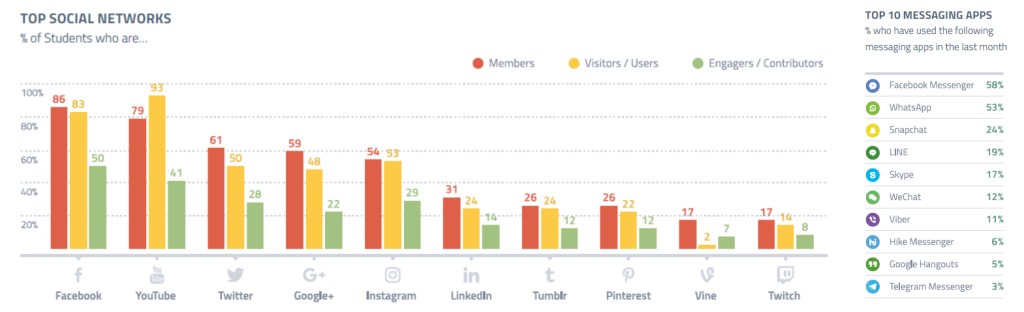
The top social media networks used by students are Facebook, YouTube, Instagram, and Twitter. When it comes to the most used messaging app Facebook Messenger has a tight battle with WhatsApp, having a difference of just 5%.

A screenshot of a cell phone

Description automatically generated

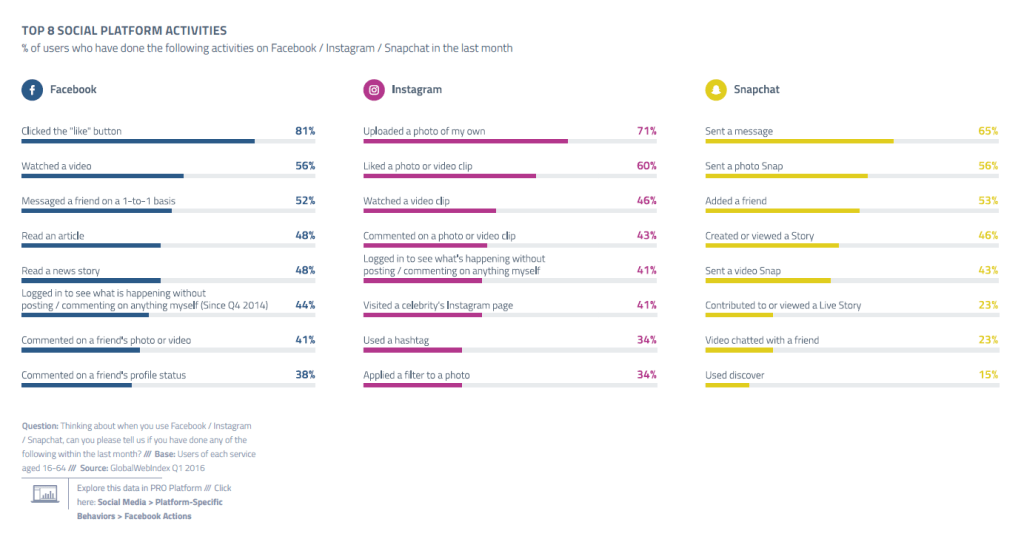
Did you ever think what most people do on social media? With the help of GWI here we have top 8 social platform activities for Facebook, Instagram and Snapchat.

Facebook is mostly used for entertainment purposes and news stories (even if I would not recommend that). Behind the main purpose of Instagram which is mainly used to upload personal photos, for students it is also a way to follow other people’s lifestyles. Snapchat is an important platform for students to keep peers updated with their daily lives. (I’m not a fan of Snapchat anyway, maybe because of this)

  • E-commerce and brand engagement
  • How students usually find and research about a brand?

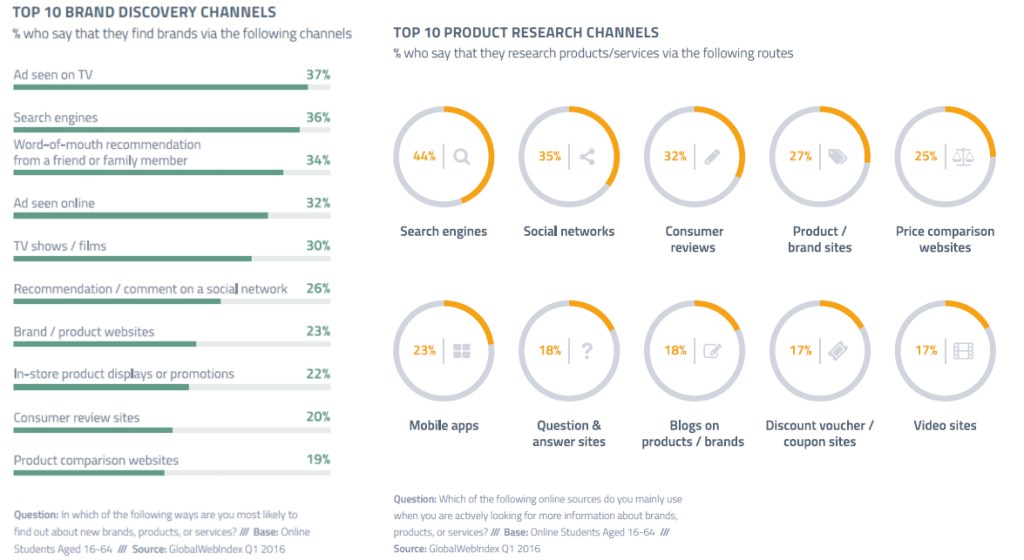
Most of the students find brands via ads on TV or search engines and 1 in 3 students discovered brands by word-of-mouth recommendation. When it comes to research, using search engines is the most popular way to research a brand, followed by social networks and consumer reviews as secondary sources of research.

  • What factors can influence a student when choosing a product online or brand?

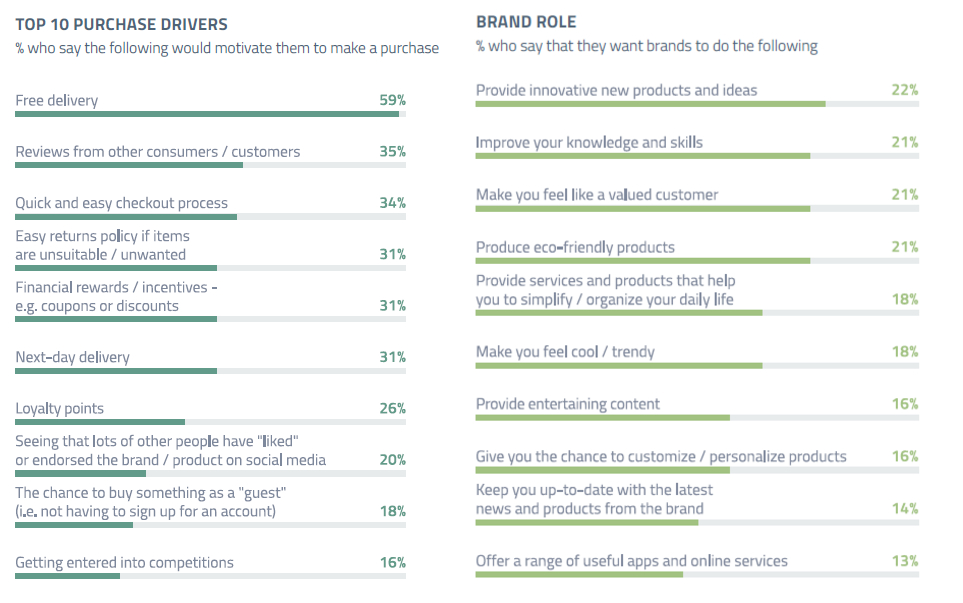
Free delivery is by far the most important factor when it comes to buying something online(59%), but also the reviews from other customers (35%) and an easy checkout/return process (34%) is important for a student. They want a brand that provides innovative new products and ideas (22%), improve knowledge and skills or is an eco-friendly product.

What do you think about these stats? Which fact do you think it is the most interesting for you? Does it apply to you? Leave a comment below!

What Brand You Like Based On Your Personality Traits

In the fourth week of the Consumer Behavior class we focused on self-concept and personality. Self-concept is an idea of the self-constructed from the beliefs that you hold about yourself and the responses of others. This plays an important role in consumer behavior as people buy products that make them feel good. Personality refers to individual differences in characteristics such as, thinking, feeling, and behaving.

The teacher introduces us to the Myers-Briggs personality test, which can reveal some interesting things about yourself. However, it is almost impossible to find a test that is 100% accurate because everybody is unique and has their own personality. But in my opinion these kind of personality tests can provide accurate results but only if :

  • You answer the questions honestly
  • You don’t have neutral answers
  • You answer quick and decisively

You can attempt the test yourself : 16 personalities test.

The system of personality types proposed by Carl Jung (1921) and later refined by C. Myers and I. M. Briggs has become an extremely widely used personality theory in self-help, business management, counselling and spiritual development contexts, but it is not commonly used in academic research where viewed sceptically.  [1]

However, because I attempted this test myself before the teacher showed it to us, I searched for another personality test that can be useful. I found The Big Five Personality test.

This model is assumed in most personality research and is the basis of many of the most well-regarded tests employed by psychologists who maintain close connections with academia. [2]

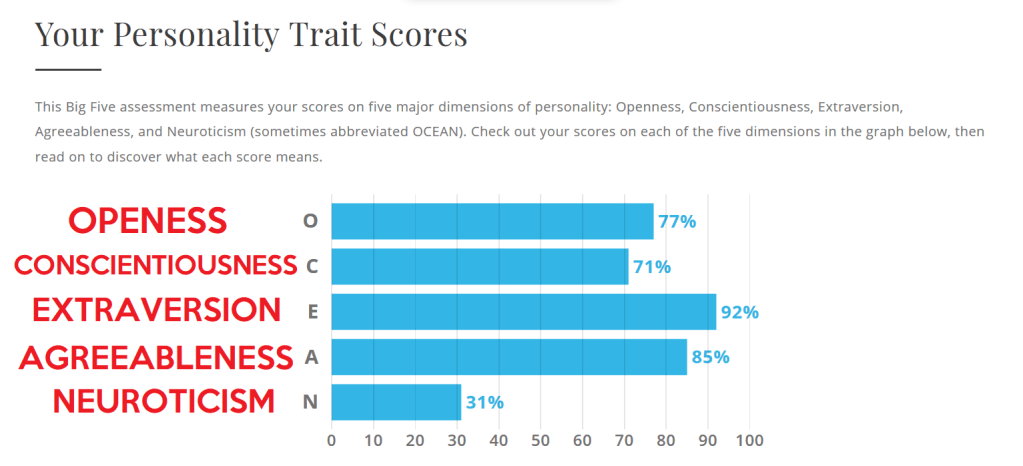
My result look like this :

A screenshot of a cell phone

Description automatically generated

In order to understand the next piece of information, you should attempt the test yourself by clicking link: The Big Five Personality test.

But how these traits are related to my brand preferences? In the research report “Congruence between brand and consumer personalities” [3]  I found that :

Previous studies in marketing and consumer behaviour field have came up with an idea that when the compatibility between the human personality and brand personality are high, there is more chance the product in question will get purchased. It is proven that consumers prefer brands with a symbolic function that suits their own identity or allows to express ideal self. The match between brand personality and consumer personality creates a relationship between both personalities, which affects the choice of goods, the intention to buy, product evaluation or attachment to the product. In conclusion the consumers choose brands not only because they highlight certain aspects of what we are or want to be, but also because brands themselves create those aspects.”

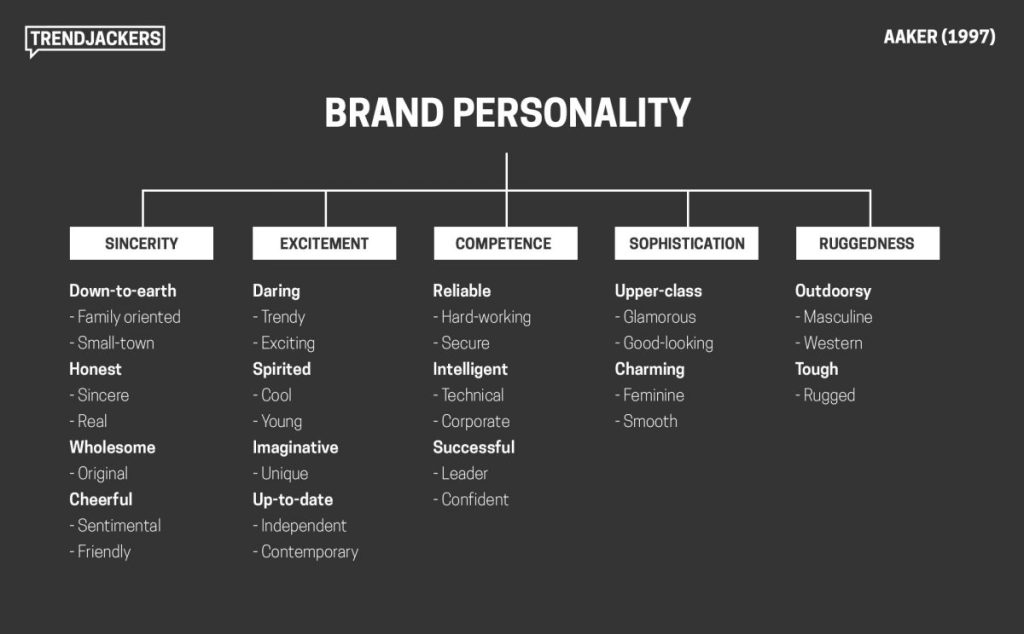
While examining the consumer personality  through the “Big Five” model and the brand personality dimensions Aaker et al.  (1997) found that several brand personality dimensions are related with several dimensions of “Big Five” model.

  • There is a relation between human personality dimensions openness to experience and competence (this might be due to the fact that both dimensions have such trait as intelligent)
  • Conscientiousness matches competence (due to similar traits such as responsibility, reliability and safety)
  • Extraversion matches excitement (due to similar traits such as sociability, energy and activity)
  • Agreeableness dimension of human personality matches sincerity dimension of brand personality (as both are composed of such traits as warmness and approval)
  • However, it still remains unclear what brand is chosen in case consumer scores high on neuroticism dimension; or what type of personality prefers brand with sophistication dimension.

The brand personality traits by Aaker (1997)

A screenshot of text

Description automatically generated

Brand Personality Model: A Modern Case Study | Trendjackers

A screenshot of a cell phone

Description automatically generated

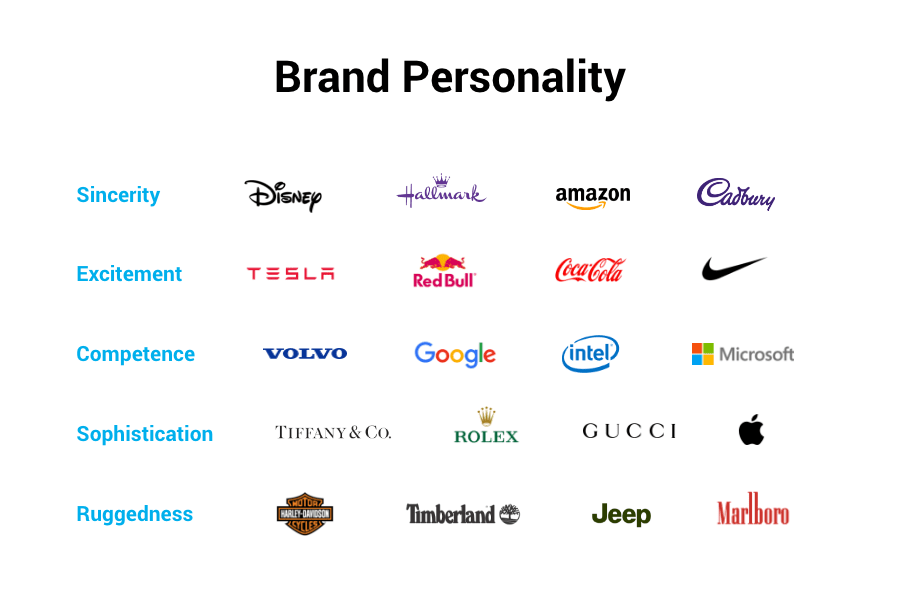
Brand Personality: Traits of Top Brands

Now, you can compare your test results with this brands personalities and see which one matches your personality !

Assuming you have taken the test, do you consider your personality to be close to the brands personality shown above? What do you think about the results? Leave me a comment down below !

What Factors Can Influence Your Decision When Spending Money

     You have probably experienced this while at a restaurant you are not familiar with, and you are not sure what meal to order. Maybe you have seen the waiter/waitress bring another customer’s meal out and you decide to order that specific meal. Maybe your friend said that you should try a certain meal. External factors can influence your decision making, even the intermediary (the waiter/waitress in this case) between the consumer (you) and the product (the food or the drink you want to buy) can be one of the many factors which can influence your decision-making process. Don’t be mistaken, nobody wants to influence you to buy something you don’t need but some people have to do that so they can be successful in their jobs. (salesmen for example) But maybe not in this case.

     On the other hand, the intermediary can influence you in a good way. Working in hospitality mostly as a bartender and also as a waiter for 4 years, I observed how I can influence other customer’s buying decision-making in a good way, helping them to find something new that they would enjoy based on their usual consumer choices.

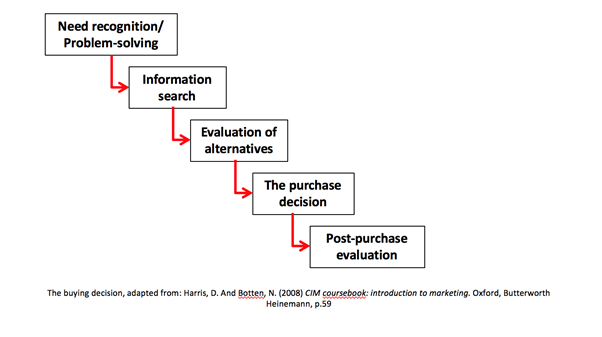
     To understand better, I will present the decision-making process showed by my teachers in the Consumer Behavior class and, I will explain from my perspective as a marketing student and part-time waiter on how you usually decide what you want to eat when you go out for a meal.

Imagine yourself at a restaurant with your friends, and it is your first time there and you are not sure what you want.

  • Need recognition/Problem-solving

The consumer (you in this case) recognises a requirement or problem (being hungry) that needs to be fulfilled.

This gets solved into two stages. The first stage is deciding where to eat and with the help of modern technology, it is easier than ever. The second stage is deciding what to eat when you arrive at the place you decided you want to have a meal.

  • Information search

The consumer seeks more information to solve the problem (checking the restaurant menu in this case).

Most people can decide what they want relatively quick, some take a bit longer and some can’t decide without the help of the waiter/waitress or other external factors like another person’s decision.

  • Evaluation of alternatives

The consumer uses the information to evaluate alternative options.

However, even if you decided or not, one alternative can be the recommendation of the waiter/waitress. This is the moment where the intermediary can influence the consumer. Based on different factors the waiter can influence you in a bad way (to buy something more expensive or something you don’t really want to try) or influence you in a good way. From my personal experience, people are not sure of what they actually want, so I try to be as close to their personal preferences asking questions like: “What type of food do you usually enjoy? If not, which ones from the menu do you dislike?”. I observed that helping the customer see fewer options by eliminating the negative products (subjectively speaking, of course) or focusing on the positive ones instead of looking at the whole menu confused was an efficient way that influenced the customer to make easier and better decisions.

  • The purchase decision

Buying the product.

Now the consumer decides what to buy, based on their first decision or the alternatives seen before.

  • Post-purchase evaluation

The consumer takes further steps after purchase based on their satisfaction and dissatisfaction.

In hospitality jobs, it is well known that a post-purchase evaluation can be associated with the “tips” or “gratuity” received, which is: “a small amount of money for someone who has provided you with a service, in addition to the official amount and for their personal use” .Tipping is optional. Generally speaking, the bigger the tip you receive the better the service you have provided. Also, in addition to that, I like to ask for feedback about the product, especially if I recommend it personally. I received a lot of positive feedback and many generous tips and I believe this is because I strive to give the best service to every customer simply based on their likes and dislikes. Sounds easy, right?

In conclusion, knowing the buying-decision process can help you to have better choices when it comes to purchasing products or services. Have you ever been influenced to spend money when you did not plan to? Has anybody influenced you to buy something that you have never tried before? If yes, what made you buy it?

How Different Generations Choose Different brands

In the first class of Consumer Behaviour, we learned about the behaviour of different target customer groups depending on their age, gender, generation or current life situation. In today’s article, I will present to you how different generations choose different brands based on an interesting 2018 WARC article I found about “How brands can effectively engage young consumers”. Being born in the first year of Generation Z (1997), I will compare my generation with the older ones when it comes to choosing a brand.

Before starting, let’s look at the 4 categories that the generation have been split in to:

  • Baby Boomer generation (born 1946-64, usually parents of Millennials)
  • Generation X (born 1965-79, usually parents of Gen Z)
  • Generation Y / Millennials (born 1980-1996)
  • Generation Z (born 1997-2012)
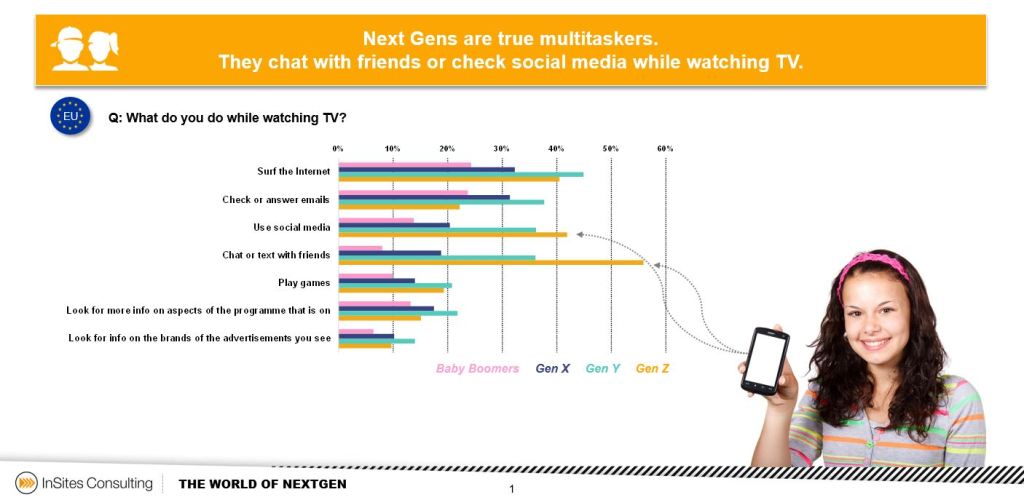
  1. 1 Generation Z has a shorter attention span than the older generations
A screenshot of a social media post

Description automatically generated

(Van den Bergh, 2018)

And a Case study: “Skincare brand Garnier developed an augmented reality app to bring Egor Kreed – Russia’s biggest pop star – to life in virtual reality. Girls who bought the Pure 3-in-1 face cleanser and downloaded Garnier’s Pure app saw a mini version of the singer greeting them by name and performing a dance routine. They could then record themselves dancing next to the pop star and share their videos on social media to win a real-life performance from Kreed. More than 21,000 unique videos were created and shared and sales of the product went up by 49%.In the image above we can observe”

Young customers are multi-screening on more than one platform at a time (most important ones being Instagram, Snapchat and YouTube), that meaning their attention needs to be captured on multichannel – on mobile, video, social as well as offline too. Millennials are more likely to play games when watching TV or look for info about the brands they see in commercials.  Older generations like X or Baby Boomers are more interested in surfing the internet and checking the e-mails as a side activity when watching TV.

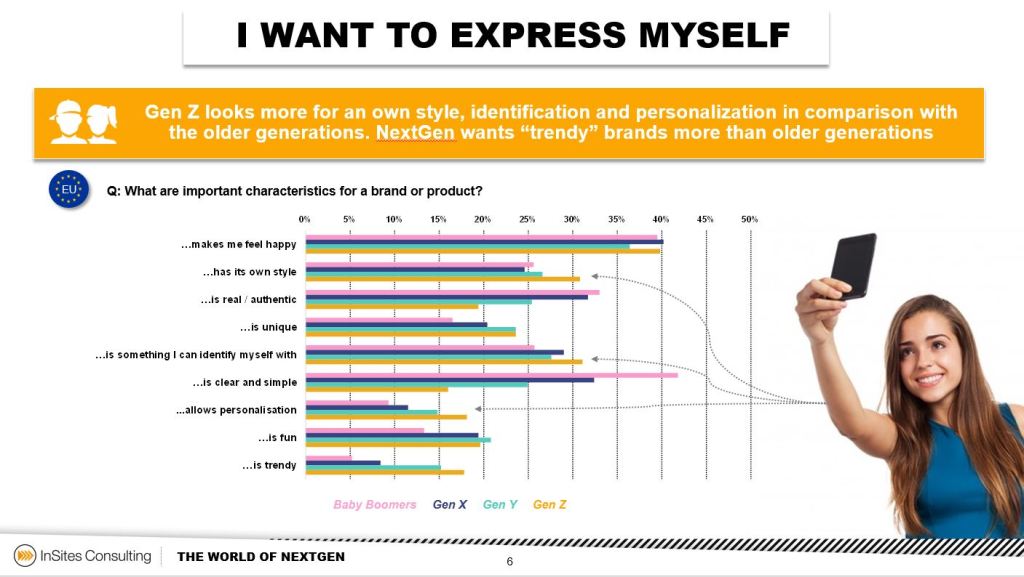
  1. 2 Generation Z looks for innovation and personalization when looking for a brand
A screenshot of a social media post

Description automatically generated

(Van den Bergh, 2018)

When it comes to what are the important characteristics for a brand or product our parents are probably looking for a clear, simple and authentic brand rather than a trendy one. Younger generations are more into more innovative, that allows personalisation and represents them as a person. But in the end, everybody is looking for a product or brand that makes them happy.

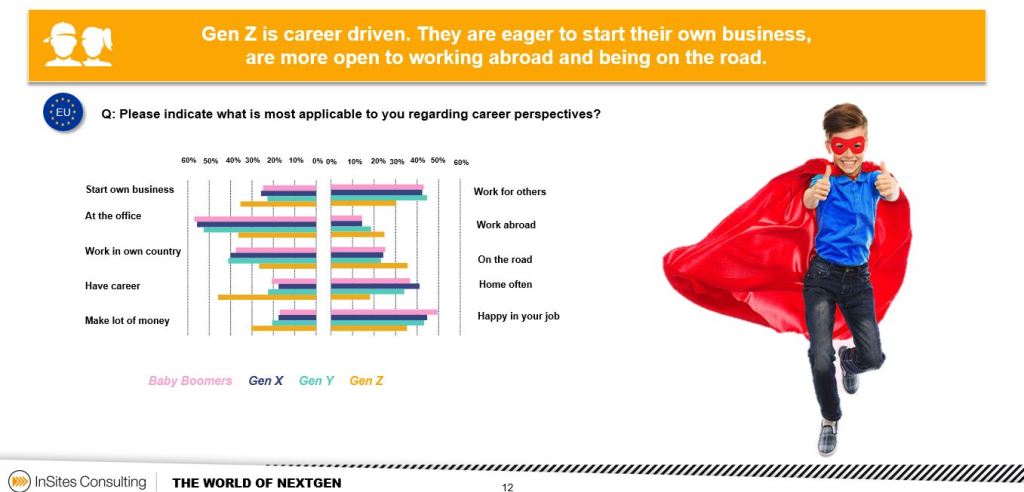
  1. 3 Generation Z appear more career-minded, willing to sacrifice fun for money
A screenshot of a cell phone

Description automatically generated

                                                          (Van den Bergh, 2018)

I must be honest and say this one surprised me in a good way. I see more and more young people wanting to start their own business and older generations are encouraging this, starting from Gary Vaynerchuk giving advice to youngsters on how to grow on social media and in business and finishing with young people like Henry who started his official business journey at the age of nine when he launched children’s brand Not Before Tea. That means that younger generations start looking for brands that show them how they can improve themselves or their lives are appreciated and products that can help them pursue their dreams and become successful in life.

Millennials are looking more for a good work/life balance and older generations are looking for a safer approach, preferring being close to family and having a secure financial situation.

In conclusion, younger generations are looking for brands that are unique and give the option to personalize their products to create their own identity or show their talent. Older generations are more likely to identify with a brand that is simpler and more practical to their needs. With the information I have given you can you relate this to yourself, your friends and your relatives (grandparents, parents, siblings, etc)?