

You have probably experienced this while at a restaurant you are not familiar with, and you are not sure what meal to order. Maybe you have seen the waiter/waitress bring another customer’s meal out and you decide to order that specific meal. Maybe your friend said that you should try a certain meal. External factors can influence your decision making, even the intermediary (the waiter/waitress in this case) between the consumer (you) and the product (the food or the drink you want to buy) can be one of the many factors which can influence your decision-making process. Don’t be mistaken, nobody wants to influence you to buy something you don’t need but some people have to do that so they can be successful in their jobs. (salesmen for example) But maybe not in this case.
On the other hand, the intermediary can influence you in a good way. Working in hospitality mostly as a bartender and also as a waiter for 4 years, I observed how I can influence other customer’s buying decision-making in a good way, helping them to find something new that they would enjoy based on their usual consumer choices.
To understand better, I will present the decision-making process showed by my teachers in the Consumer Behavior class and, I will explain from my perspective as a marketing student and part-time waiter on how you usually decide what you want to eat when you go out for a meal.
Imagine yourself at a restaurant with your friends, and it is your first time there and you are not sure what you want.
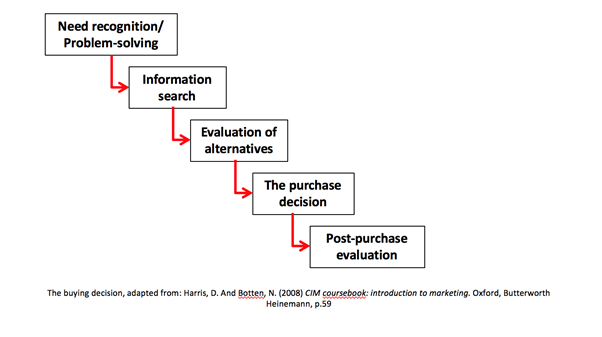
- Need recognition/Problem-solving
The consumer (you in this case) recognises a requirement or problem (being hungry) that needs to be fulfilled.
This gets solved into two stages. The first stage is deciding where to eat and with the help of modern technology, it is easier than ever. The second stage is deciding what to eat when you arrive at the place you decided you want to have a meal.
- Information search
The consumer seeks more information to solve the problem (checking the restaurant menu in this case).
Most people can decide what they want relatively quick, some take a bit longer and some can’t decide without the help of the waiter/waitress or other external factors like another person’s decision.
- Evaluation of alternatives
The consumer uses the information to evaluate alternative options.
However, even if you decided or not, one alternative can be the recommendation of the waiter/waitress. This is the moment where the intermediary can influence the consumer. Based on different factors the waiter can influence you in a bad way (to buy something more expensive or something you don’t really want to try) or influence you in a good way. From my personal experience, people are not sure of what they actually want, so I try to be as close to their personal preferences asking questions like: “What type of food do you usually enjoy? If not, which ones from the menu do you dislike?”. I observed that helping the customer see fewer options by eliminating the negative products (subjectively speaking, of course) or focusing on the positive ones instead of looking at the whole menu confused was an efficient way that influenced the customer to make easier and better decisions.
- The purchase decision
Buying the product.
Now the consumer decides what to buy, based on their first decision or the alternatives seen before.
- Post-purchase evaluation
The consumer takes further steps after purchase based on their satisfaction and dissatisfaction.
In hospitality jobs, it is well known that a post-purchase evaluation can be associated with the “tips” or “gratuity” received, which is: “a small amount of money for someone who has provided you with a service, in addition to the official amount and for their personal use” .Tipping is optional. Generally speaking, the bigger the tip you receive the better the service you have provided. Also, in addition to that, I like to ask for feedback about the product, especially if I recommend it personally. I received a lot of positive feedback and many generous tips and I believe this is because I strive to give the best service to every customer simply based on their likes and dislikes. Sounds easy, right?
In conclusion, knowing the buying-decision process can help you to have better choices when it comes to purchasing products or services. Have you ever been influenced to spend money when you did not plan to? Has anybody influenced you to buy something that you have never tried before? If yes, what made you buy it?
 Savouring Marketing
I work in a jewellers and I can relate to you that it’s our job to help the consumers make a purchase decision. I feel it’s important to be honest and find out as much as possible about the consumer so that they make the right choice and don’t feel guilty or unimpressed in the post-purchase stage.
LikeLiked by 1 person
Most of us probably don’t even recognize we do this decion-making process when buying a product but it happens every time, even if unconsciously!
This post is really well structured and you did a good job explaining the decision-making process while giving examples to each stage. It makes it easer to understand the theory.
LikeLiked by 1 person
This is a good blog, it’s really well referenced! I usually have a set item in mind when I go to a restaurant, I find them really stressful though so I’m probably not the typical customer.
The only real suggestion I can make to potentially improve the blog would be slice the segments down a little. But that could be personal opinion
LikeLiked by 1 person
Nice blog about decision making Popa. Explained clearly how we can be influenced in our decisions, with actual steps that we take until we come to a decision. I have found myself a few times fully going through this process even though I didn’t recognize it at first. Keep up the good work with the blogs.
LikeLiked by 1 person
Nice post! I woud like to see a second part with more details.
LikeLike